

There is a moment that every bird sculpture tries to capture. It might be the instant a wing lifts, the pause before takeoff, or the stillness of a bird at rest. Whatever the moment, the challenge is the same: how do you hold flight in a material that cannot fly?
Birds have been a subject of sculpture for thousands of years. From the carved stone falcons of ancient Egypt to the bronze eagles of imperial Rome, from the ceramic cranes of Japanese tradition to the stainless steel swallows of contemporary public art, birds appear wherever humans have made art. They are among the most universal subjects in sculpture, found in every culture and every era.
What makes birds so compelling as a sculptural subject? Part of it is the sheer beauty of their forms—the sweep of a wing, the curve of a neck, the delicate architecture of a feather. Part of it is the symbolism they carry. Birds represent freedom, aspiration, peace, wisdom, and the connection between earth and sky. They are messengers, spirits, and companions. And part of it is the impossibility of the task itself. A sculpture cannot fly. But the best bird sculptures make you believe it might.

Why Birds Are Made for Sculpture
Birds possess qualities that make them uniquely suited to three-dimensional representation.
The Beauty of Form
A bird's body is an exercise in elegant design. The curve of a wing, the taper of a tail, the angle of a beak—each element has been refined by millions of years of evolution into something close to perfect. Sculptors are drawn to this form because it rewards close attention. A feather, a claw, the glint of an eye—the details matter.
The Language of Movement
Birds are defined by motion. Flight is their most characteristic act. A sculpture that captures a bird in motion—a swallow diving, an eagle climbing, a hummingbird suspended in midair—achieves something that few other subjects can. It freezes the unfreezable. It makes stillness feel dynamic. This is why a bronze bird sculpture in flight can feel more alive than almost any other subject.
Universal Symbolism
Birds carry meaning across cultures. Eagles represent power and vision. Doves represent peace and hope. Owls represent wisdom and mystery. Cranes represent longevity and grace. Swans represent beauty and transformation. A bird sculpture communicates before a single word is spoken.
Emotional Resonance
Birds are part of everyday life. They wake us in the morning, cross our skies at dusk, and appear in our gardens throughout the year. They are creatures we feel connected to, even from a distance. A garden bird sculpture brings that connection outdoors, preserving it in permanent form.

Popular Bird Species in Sculpture
Different bird species carry different meanings and lend themselves to different sculptural treatments. Here are five of the most beloved subjects in bronze and stainless steel.
Eagles: Power and Vision
The eagle is the most powerful symbol in bird sculpture. It represents strength, courage, freedom, and vision. Eagles have been used as national emblems for centuries—from ancient Rome to the United States—and they remain one of the most popular subjects for public monuments and corporate art.
An eagle sculpture is never just a decoration. It is a statement. A bronze eagle with wings spread, talons extended, and eyes fixed on the horizon commands attention. It speaks of leadership, ambition, and the ability to see what others miss.
Eagles are also popular in smaller scale. A bronze eagle perched on a branch, alert and watchful, conveys the same qualities of vision and focus in a more intimate format. For corporate lobbies, stainless steel eagles offer a modern interpretation—sleek, reflective, and forward-looking.
What Eagles Symbolise: Power and strength; Vision and leadership; Freedom and independence; Courage and determination; National pride
Ideal Placements: Corporate headquarters, government buildings, public monuments, entryways, executive offices, and large gardens.
Best Materials: Bronze for traditional and monumental works. Stainless steel for contemporary corporate settings. Both materials convey the strength and presence that the eagle demands.

Cranes: Grace and Longevity
The crane is one of the most elegant subjects in bird sculpture. With its long neck, slender legs, and sweeping wings, the crane embodies grace, patience, and longevity. In East Asian art, the crane is a symbol of good fortune and eternal youth. In Japanese tradition, it is said that anyone who folds a thousand paper cranes will be granted a wish. In Chinese art, the crane represents longevity and immortality, often depicted alongside pine trees and rocks.
Cranes are often sculpted in pairs or family groups, representing loyalty and lifelong partnership. A pair of bronze cranes standing together in a garden creates a scene of quiet harmony, while a single crane in flight captures a moment of pure grace.
What Cranes Symbolise: Longevity and immortality; Grace and elegance; Loyalty and partnership; Peace and tranquility; Good fortune.
Ideal Placements: Garden ponds, meditation gardens, entryways, landscapes, corporate gardens, and any space seeking a sense of calm and refinement.
Best Materials: Bronze and marble are particularly well-suited to cranes, capturing the delicate texture of feathers and the soft curve of the neck. Stainless steel offers a more contemporary interpretation with its reflective surface.

Small Birds: The Joy of Interaction
Not every bird sculpture needs to be monumental. Some of the most charming and emotionally engaging works feature small birds—sparrows, finches, robins, swallows, and wrens—in moments of everyday life.
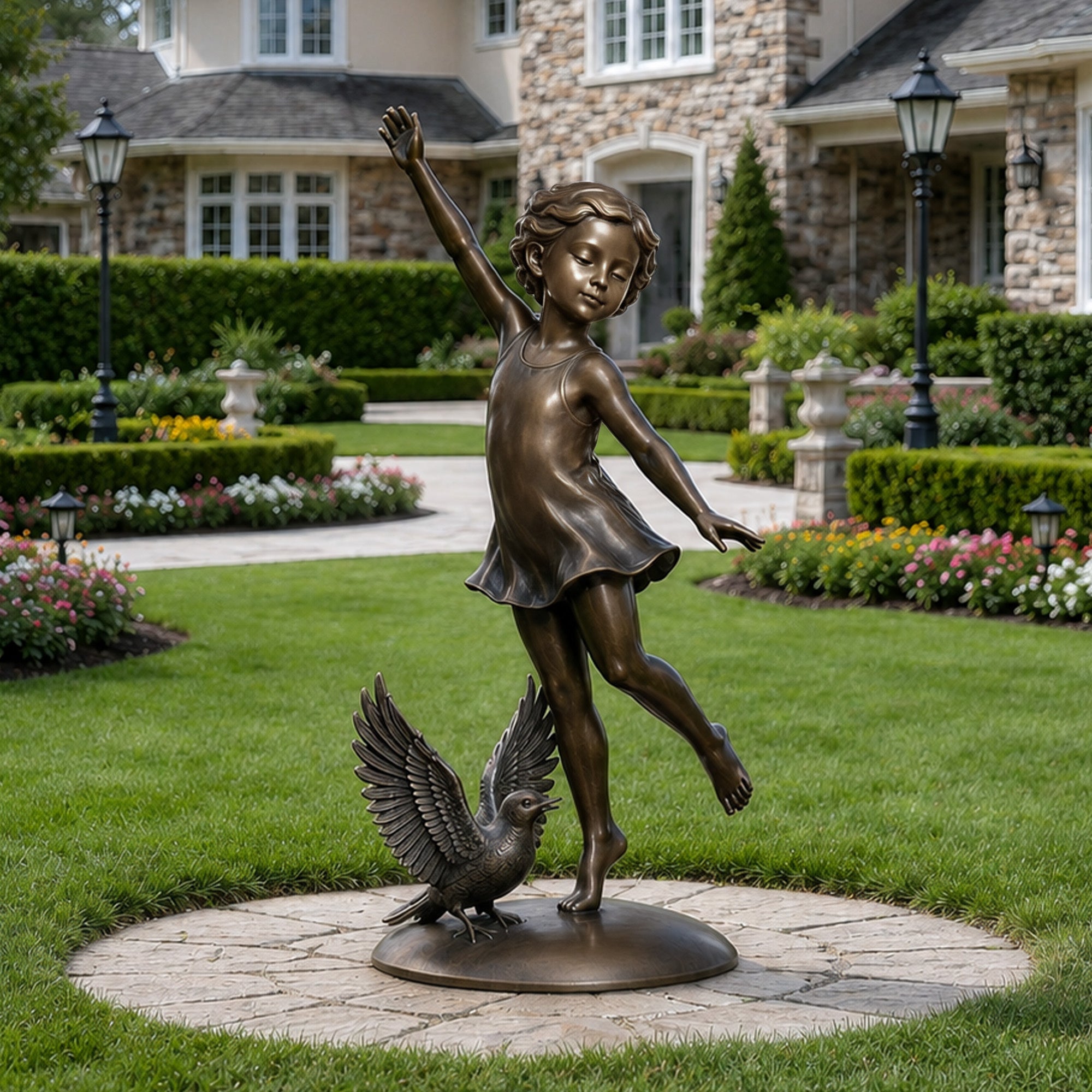
These small bird sculptures are particularly effective when they interact with human figures. A bronze child holding a bird in cupped hands. A seated figure with a bird perched on the shoulder. A pair of hands reaching out to a small bird that has landed on a finger. These compositions capture the delicate relationship between humans and nature. They speak of trust, gentleness, and the simple joy of connecting with another living creature.
Small bird sculptures are also effective on their own. A swallow in flight. A robin on a branch. A sparrow at a birdbath. These works bring a sense of life and movement to indoor and outdoor spaces, and they are small enough to fit almost anywhere.
What Small Birds Symbolise: Joy and lightness; Freedom and simplicity; Connection between humans and nature; Trust and gentleness; Everyday beauty
Ideal Placements: Home interiors, bookshelves, bedside tables, garden niches, children's spaces, and memorial gardens.
Best Materials: Bronze is the most popular material for small bird sculptures, offering warmth, detail, and a sense of intimacy. Its weight and texture make the piece feel substantial despite its size.

Peacocks: Beauty and Pride
The peacock is one of the most visually spectacular subjects in bird sculpture. With its iridescent plumage, sweeping tail, and regal posture, the peacock is a symbol of beauty, pride, royalty, and elegance.
In many cultures, the peacock represents immortality, resurrection, and the all-seeing eye of God. In Christian symbolism, the peacock's tail—with its hundred eyes—represents the all-seeing wisdom of God. In Hinduism, the peacock is associated with Saraswati, goddess of wisdom and learning. In Chinese culture, it represents peace, prosperity, and good fortune.
Peacock sculptures are particularly striking in bronze, where the patina can be treated to create the rich blues and greens of the bird's plumage. A bronze peacock with its tail fanned out is a magnificent sight—a centerpiece that commands any garden or interior.
What Peacocks Symbolise: Beauty and elegance; Pride and royalty; Wisdom and vision; Immortality and renewal; Good fortune and prosperity
Ideal Placements: Formal gardens, luxury estates, hotel lobbies, entryways, and any space that celebrates beauty and grandeur.
Best Materials: Bronze is the ideal material for peacocks, capturing the iridescent quality of the plumage. The patina can be carefully controlled to replicate the rich blues, greens, and golds of the bird's natural colours.

Penguins: Charm and Companionship
The penguin is a bird that captures hearts. Flightless yet graceful in water, penguins are symbols of adaptability, community, and resilience. They are known for their playful nature, their monogamous partnerships, and their ability to thrive in the most challenging environments.
Penguin sculptures range from realistic to whimsical. A pair of bronze penguins standing together, huddled close, represents companionship and family. A playful penguin sliding on its belly brings a touch of humour and joy. A family of penguins—two adults and a chick—evokes warmth and care.
In many environments, penguins are associated with childhood, winter, and the magic of the natural world. They appeal to children and adults alike, making them ideal for family spaces, gardens, and public art installations.
What Penguins Symbolise: Companionship and family; Resilience and adaptability; Playfulness and joy; Community and cooperation; The beauty of the natural world.
Ideal Placements: Family gardens, playgrounds, coastal settings, children's spaces, and any environment that celebrates warmth and charm.
Best Materials: Bronze and fiberglass work beautifully for penguins. Bronze offers warmth and permanence, while fiberglass allows for playful colours and larger-than-life scale.

Caring for Your Bird Sculpture
Bronze: Clean with mild soap and water. Apply a protective wax once or twice a year to preserve the patina.
Stainless Steel: Rinse with fresh water to remove dust and debris. Clean with mild soap and a soft cloth. Avoid abrasive cleaners.

Birds have inspired sculptors for thousands of years. They are creatures of beauty, motion, and meaning. They represent the freedom we long for, the grace we admire, and the connection between earth and sky that has fascinated humans since the beginning.
Whether you choose a bronze crane for a garden pond, a stainless steel eagle for a corporate lobby, a pair of penguins for a family space, a peacock for a formal estate, or a small bird interacting with a human figure for a memorial garden, a bird sculpture brings something special to any space. It is not just a representation of an animal. It is a symbol. A presence. A piece of the sky brought down to earth.
Explore our collection of bird sculptures—available in bronze, stainless steel, marble, and fiberglass. Find the piece that captures flight for your space.